
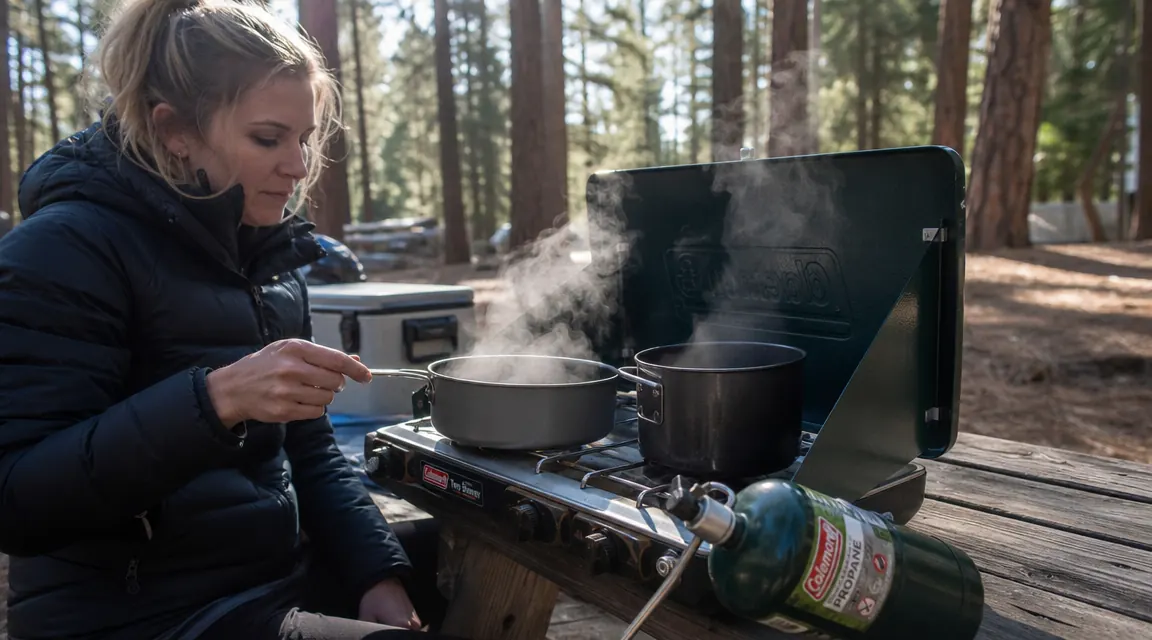
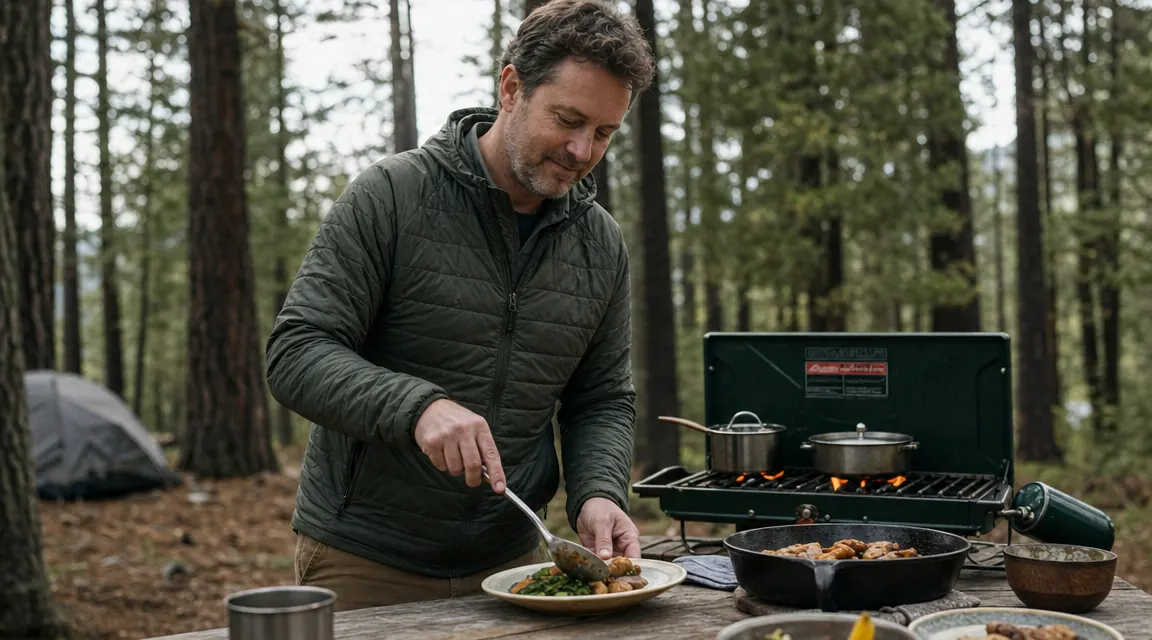
The first time I pushed the Camp Chef Explorer to its limit, I was cooking breakfast for six at a campsite near Steamboat Springs, Colorado. Elevation 8,400 feet. A cold front had rolled in overnight, and the wind was moving fast enough to bend the tent rainfly. I had a 12-inch Lodge skillet full of eggs and sausage on the left burner and a 3-quart pot of water coming to a boil on the right. The Explorer did not stutter. I have been cooking on this stove for the better part of four years now, and that morning is still the clearest proof I have that the product does exactly what Camp Chef says it does.
The Camp Chef EX60LW Explorer is a two-burner propane camp stove with 30,000 BTU per burner, a 14-by-32-inch cooking surface, and a modular leg system that accepts Camp Chef's full accessory line, including their griddle, barbecue box, and pizza oven. It weighs just over 12 lbs with legs attached. I bought mine on Amazon in the spring of 2020 and it has come on somewhere around 60 weekend camping trips since then. Here is what I know about it after that time.
The Quick Verdict
The strongest BTU output in its price class, a cook surface that takes real cookware, and a modular system that actually expands your camp kitchen without buying a second stove.
Amazon Check Today's Price →If you cook real food at camp, this stove ends the upgrade cycle.
The Camp Chef Explorer runs 30,000 BTU per burner, handles cast iron, and fits most standard propane tanks. Check today's price on Amazon before your next trip.
Amazon Check Today's Price on Amazon →How I Have Used It
My baseline use case is car camping with my wife and two kids, aged 10 and 13, at Colorado State Park campgrounds in the Front Range. Typical trip is two or three nights. I cook one real dinner and one real breakfast per trip. That means pasta or chili one night, eggs and bacon the next morning, and some kind of boiled coffee setup both days. The Explorer handles all of this without any adaptation.
In the summer of 2022, my brother and his family joined us for a week-long trip at Staunton State Park, and we pushed the stove harder. We were cooking for eight people at once, which meant the Explorer ran both burners at near-full heat for 45 minutes at a stretch. I was watching closely for any sign of heat fatigue on the burner valves and did not see any. The folding legs held steady on an uneven picnic table the whole week.
I have also used this stove solo on a few spring shoulder-season trips where the temp at night dropped to about 28 degrees Fahrenheit. Propane performance drops in cold because of vapor pressure, but with a standard 1-pound canister I noticed flame loss below about 35 degrees. Switching to a larger 5-pound vertical tank solved the problem. If you camp regularly in cold conditions, plan on the larger tank.
BTU Output: What 30,000 Actually Does
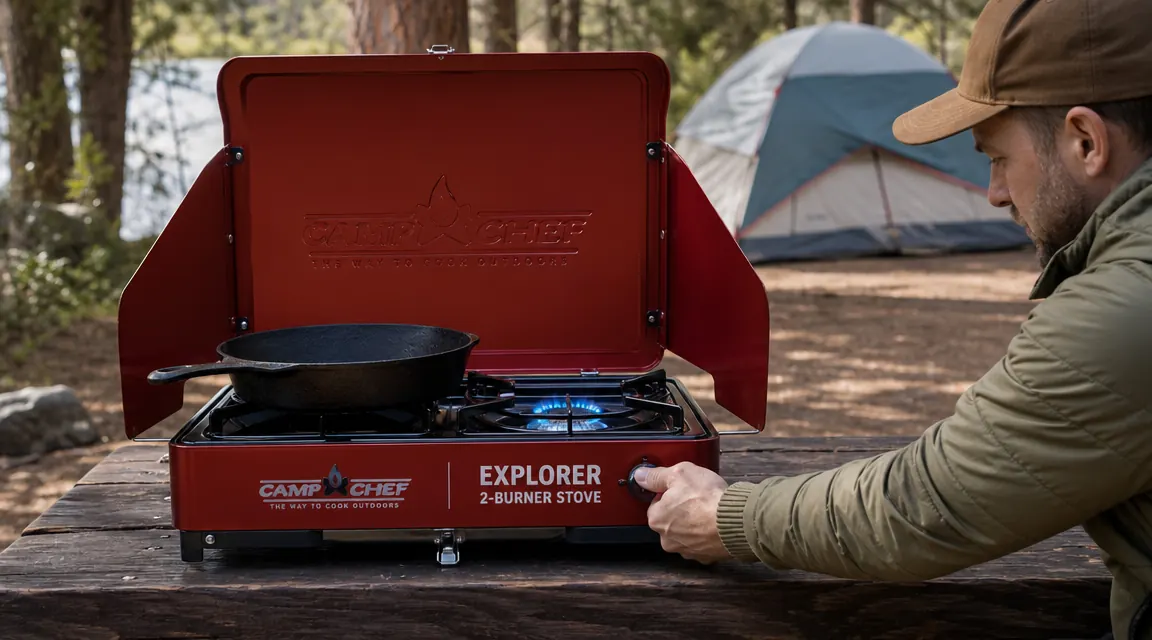
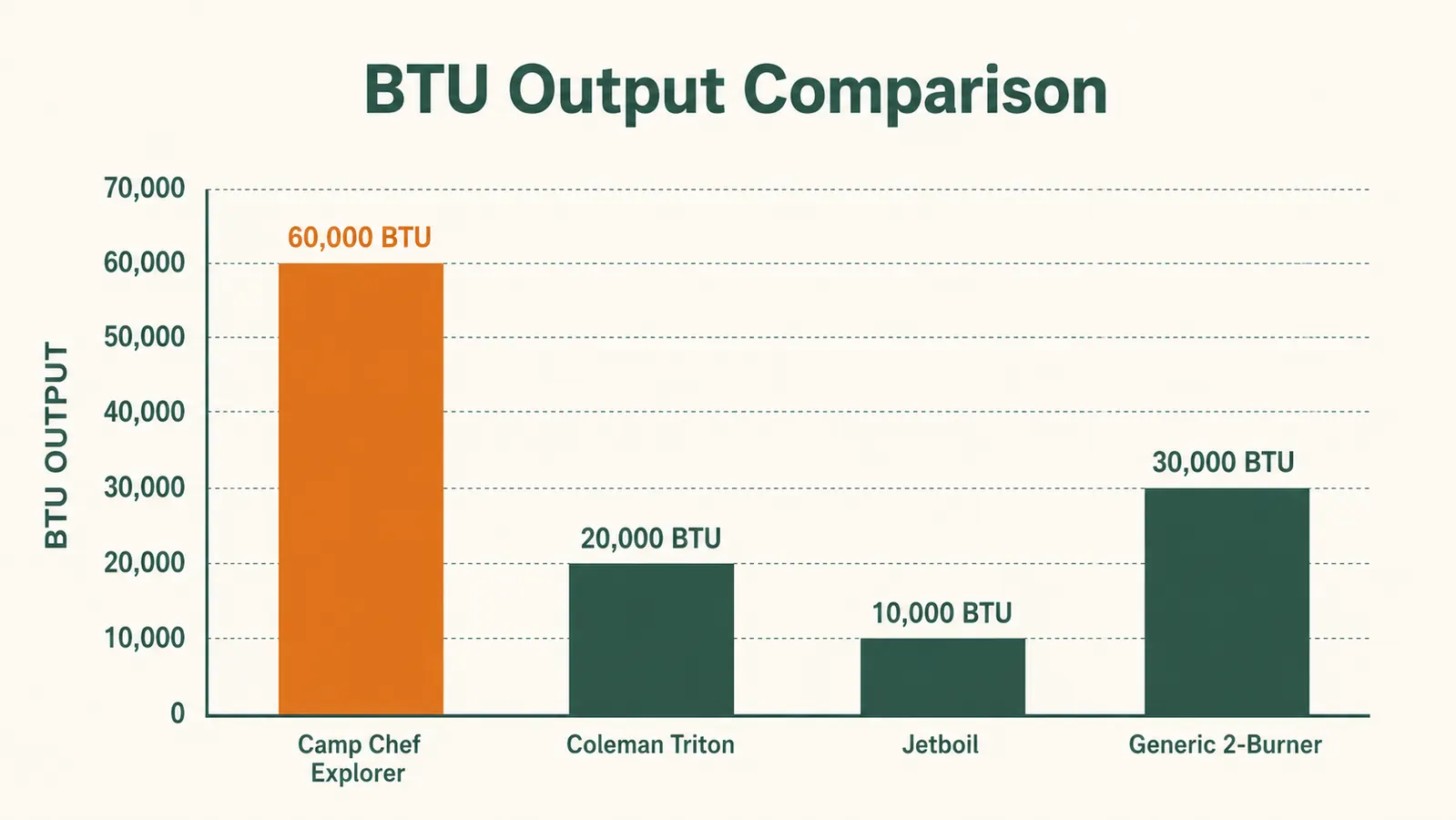
Most two-burner camp stoves in the budget bracket run around 10,000 BTU per burner. The Coleman Classic, the Triton, a lot of the Amazon mid-range options. The Explorer runs 30,000 BTU per burner. That is not a marginal difference. It is three times the heat output, and it shows in boil times. On a calm 60-degree morning, I can bring 4 quarts of water from cold to a rolling boil in about 8 minutes on the Explorer. The same task takes 18 to 22 minutes on a 10,000-BTU burner.
The practical result is that I do not change how I cook at camp. I cook the way I cook at home. I can sear. I can run a high simmer for a sauce. I can use a cast iron griddle without waiting 15 minutes for it to come up to temperature. When you drop to 10,000 BTU, you start cooking differently, pacing differently, and accepting that some things just take longer outside. With the Explorer, that mental adjustment mostly disappears.
The wind screen built into the stove body helps. It is a pressed-steel side panel that folds out on each side and a back panel that surrounds three sides of the cooking grate. In direct wind it does not make the stove windproof, but it keeps a usable flame at wind speeds where a side-open stove would struggle. The morning in Steamboat with the 30 mph wind, I had the windscreen fully extended and was able to maintain cooking heat on both burners.
I do not change how I cook at camp. I cook the way I cook at home. That is worth 12 lbs.
The Cooking Surface and Cookware Compatibility
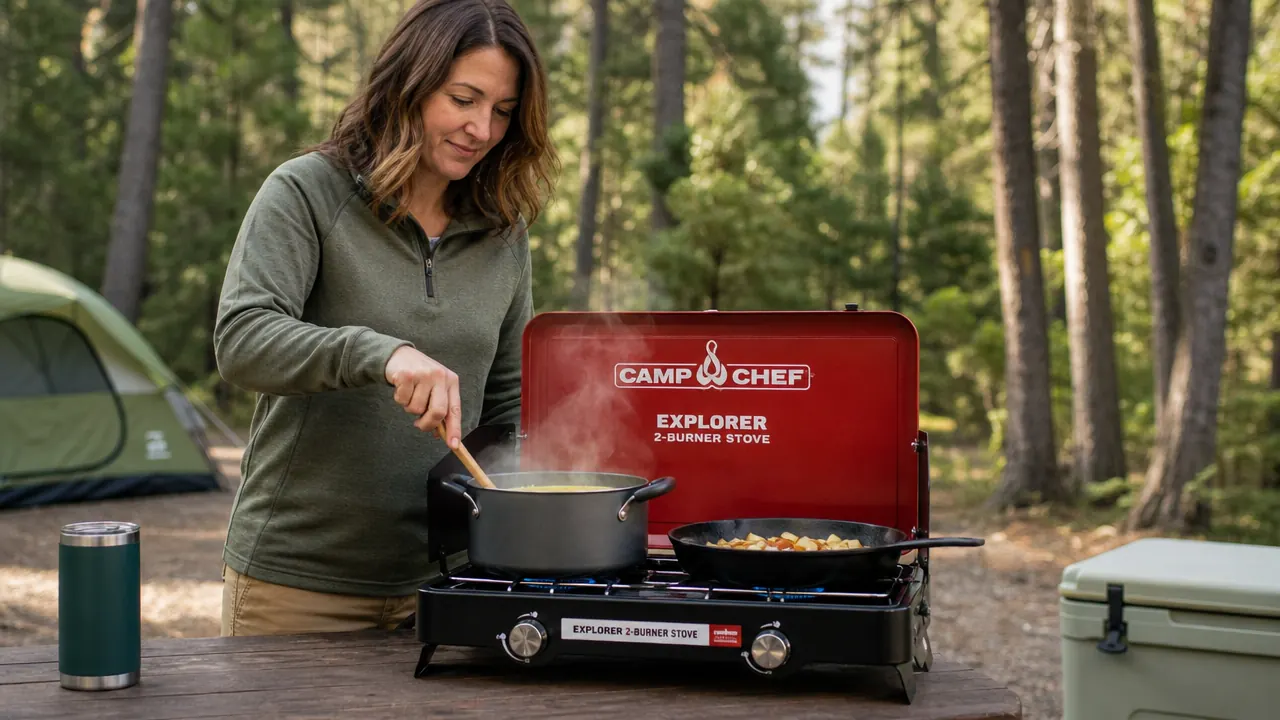
The cooking grate on the Explorer is cast iron. Not painted steel, not chrome, cast iron. Each grate section is about 14 by 14 inches, giving you a total surface of roughly 14 by 32 inches across both burners. The grate height is 3.5 inches above the burner head, which is enough clearance for airflow under a flat-bottomed pan. I run a 10-inch Lodge skillet on one side and a 5-quart Dutch oven on the other with no issues.
Most budget camp stoves have a chrome-coated wire grate. Those grates flex under a 10-pound cast iron skillet, and the wire pattern creates hot spots. The Explorer's cast grate does not flex. A 12-inch skillet sits flat, heats evenly, and does not wobble. If you cook with cast iron at all, this distinction alone may be worth the price difference between the Explorer and a cheaper stove.
The grate also lifts out cleanly for cleaning, and the drip tray under the burners slides out from the front. I do not scrub the tray every trip. I pull it out, dump it, and wipe it with a paper towel. On extended trips I'll hit it with a brush and a little soap. Four years of this treatment and the tray shows no rust.
Modular Accessory System: How Much of It Is Actually Useful
Camp Chef markets the Explorer as a modular cooking system. The legs have mounting points that accept their barbecue box, griddle, and pizza oven attachments. I own the 16-inch griddle accessory and use it regularly. The griddle drops onto the cooking grate and covers both burners, turning the stove into a flat-top. Pancakes, smash burgers, and hash browns all work better on it than on a skillet. It is an add-on and I think it is the only modular piece most campers actually need.
The pizza oven and barbecue box attachments are real products that work, but they change the trip logistics significantly. The pizza oven weighs about 30 lbs on its own. The barbecue box turns the stove into a pellet grill, which requires bringing pellets. I have not bought either because the weight and setup time do not fit a weekend car camping trip for me. If you run a fixed-site base camp for a week at a time, the modular attachments start making more sense.
The 12-Pound Weight: Is It a Problem
This stove weighs 12.4 lbs with the legs attached, 11 lbs with legs removed. A Coleman Classic 2-burner weighs about 10 lbs. A Coleman Triton weighs about 11 lbs. The Explorer is not dramatically heavier than its competition in absolute terms, but it is bulkier. The legs and cooking surface make it a roughly 14-by-32-by-7-inch package when folded. It takes up the footprint of a medium-sized duffel bag in the truck bed.
For car camping, this is not a real problem. You load it into the truck once and drive it to the campsite. The legs unfold in about 30 seconds. The issue comes up if you are doing a hike-in car camping situation where you carry gear to a walk-in site. For that scenario, I would look at the Camp Chef Everest or a smaller single-burner. For the standard pull-in drive-up campsite that covers 90 percent of what I do, the weight is irrelevant.
One practical note: the carry handle is a wire bail at the top center of the stove. When the stove is loaded with pots it is easy to grab. When it is empty it bounces slightly because the legs are folded inside. I wrap a bungee cord around the whole unit when I load it in the truck, which keeps it from sliding around in the bed.
What I Liked
- 30,000 BTU per burner is triple the output of most budget stoves at this price
- Cast iron cooking grate is stable under heavy cast iron cookware
- Built-in three-panel windscreen holds a usable flame in moderate wind
- Modular leg system accepts Camp Chef griddle, barbecue box, and pizza oven
- Drip tray and grate both remove for easy cleaning
- Compatible with both 1-lb canisters and standard vertical propane tanks via adapter hose
- 4.7 stars across nearly 9,500 reviews on Amazon, strong long-term track record
Where It Falls Short
- At 12.4 lbs it is bulky for a walk-in site or canoe portage
- No auto-ignition (piezo) on all models, check the listing before ordering
- Propane performance drops below 35 degrees Fahrenheit; larger tank needed in cold weather
- The folded unit takes up significant truck-bed real estate compared to a compact stove
- Modular accessories (griddle, pizza oven) are sold separately and add cost and weight
Alternatives I Considered
Before buying the Explorer I used a Coleman Classic 2-burner for three years. The Classic costs less and is lighter by about 2 lbs. It is also limited to 10,000 BTU per burner, has a wire grate that flexes under cast iron, and no modular attachment system. For light camping and simple cooking, the Classic is fine. If you want to cook real food at camp, the BTU gap between the Explorer and the Classic is the reason to step up.
The Coleman Triton is the other obvious comparison. It also runs 10,000 BTU per burner and adds a matchless igniter. The igniter is convenient, but I would rather have three times the BTU and use a lighter than have an igniter and accept lower heat output. The Triton is a solid stove for light camping; the Explorer is for people who take cooking seriously at camp. You can read more on that comparison in my head-to-head on the Camp Chef Explorer vs Coleman Triton.
Who This Is For
The Explorer is built for car campers who cook real meals. If you are feeding a family, cooking with cast iron, or doing anything more involved than boiling water for instant oatmeal, this stove is the right tool. The high BTU output shortens every cook time, the stable grate handles serious cookware, and the modular system gives you room to expand your camp kitchen over time without buying a second stove. At the current price on Amazon, it is one of the strongest value plays in the camp kitchen category. If you want to go deeper on what to actually cook on it, the guide to cooking real camp meals on a two-burner stove walks through the techniques I use on every trip.
Who Should Skip It
If your cooking at camp is limited to heating canned soup and boiling water for coffee, the Explorer is more stove than you need. A smaller, cheaper burner will do that without eating up space in the truck. If you do walk-in sites or any kind of hiking-in setup, 12 lbs is too heavy and you should look at backpacking stoves or the compact single-burner options. And if budget is the primary constraint, the Coleman Classic will cook simple food at camp without issues. You can also see why a two-burner format matters in the first place over in 10 reasons a two-burner stove beats a single burner.
The stove that changed how I cook at camp is still the same price it was when I bought it.
Four years, 60-plus trips, and it still lights clean and holds heat. The Camp Chef Explorer is on Amazon with Prime shipping. Check today's price and see what version is in stock.
Amazon Check Today's Price on Amazon →