

The first time I set up the Coleman 6-person Instant Tent, I was at Champoeg State Park in Oregon with my wife, three kids, and a golden retriever named Biscuit who treats any fabric structure as a personal trampoline. It was 5 PM, the sky had that dark gray Pacific Northwest look I know well, and I had 45 minutes before I needed to start dinner. I pulled the tent out of the bag, unfolded the pre-attached pole frame, and had the thing standing in about 90 seconds flat. That part is real. The 1-minute setup claim is not pure marketing fiction.
That was 14 trips ago. The tent is now on its third camping season and has been through two hard rain events, one surprise overnight frost in the Cascades, and more Saturday-morning coffee-and-cards sessions inside it than I can count. I paid close attention to what held up and what did not, because when you are hauling a 20.5-lb bag out of a minivan and into a campsite with three kids underfoot, you want to know the tent earns its spot in the pile.
The Quick Verdict
The fastest legitimate family tent setup on the market, with enough floor space for six adults to sleep without touching elbows, but the 1000mm rain fly is not an all-weather solution, and the bag is a two-person carry.
Amazon Check Today's Price →If setup time matters to your camping crew, this is the tent to check.
The Coleman Instant Tent 6-Person is currently available on Amazon. Pre-attached poles, 68 square feet of floor space, and a weight that stays under 21 lbs. Worth checking today's price before your next trip.
Amazon Check Today's Price on Amazon →How I Have Used It Over Three Seasons
Fourteen trips, all car camping. Campsites in Oregon, Washington, and one trip to the Eastern Sierra in California. Six of those trips were with all three kids plus my wife, full six-person capacity. The other eight were couples or small-group trips where we used the extra space for gear storage. Temperatures ranged from a sticky 82-degree August night at a Columbia River campsite to a 29-degree surprise frost in October near Bend. Two of those trips included sustained rain of more than an hour.
I am not a backpacker or a mountaineer. I drive to the campsite, pull up next to the pad, and set up within 30 yards of the car. This tent is built for exactly that use case. It weighs 20.5 lbs and the bag is 25 inches long by 12 inches wide, it goes in the back of the minivan, not in a pack. If you are hike-in camping, this is not your tent. If you are car camping with more than three people, read on.
Setup Speed: What the 1-Minute Claim Actually Means
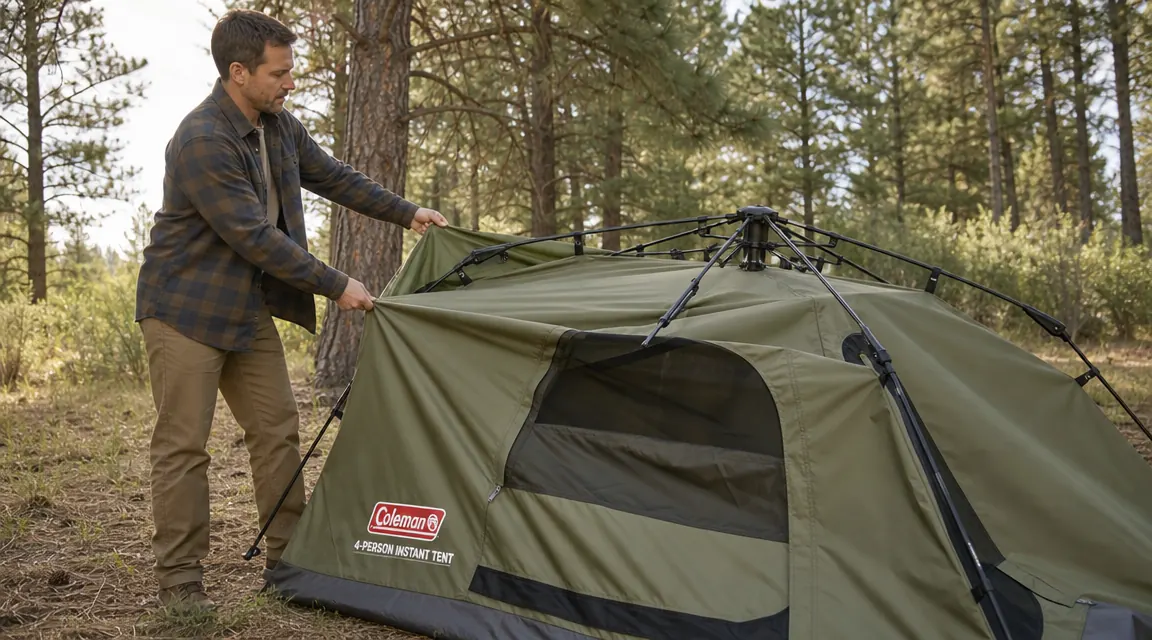
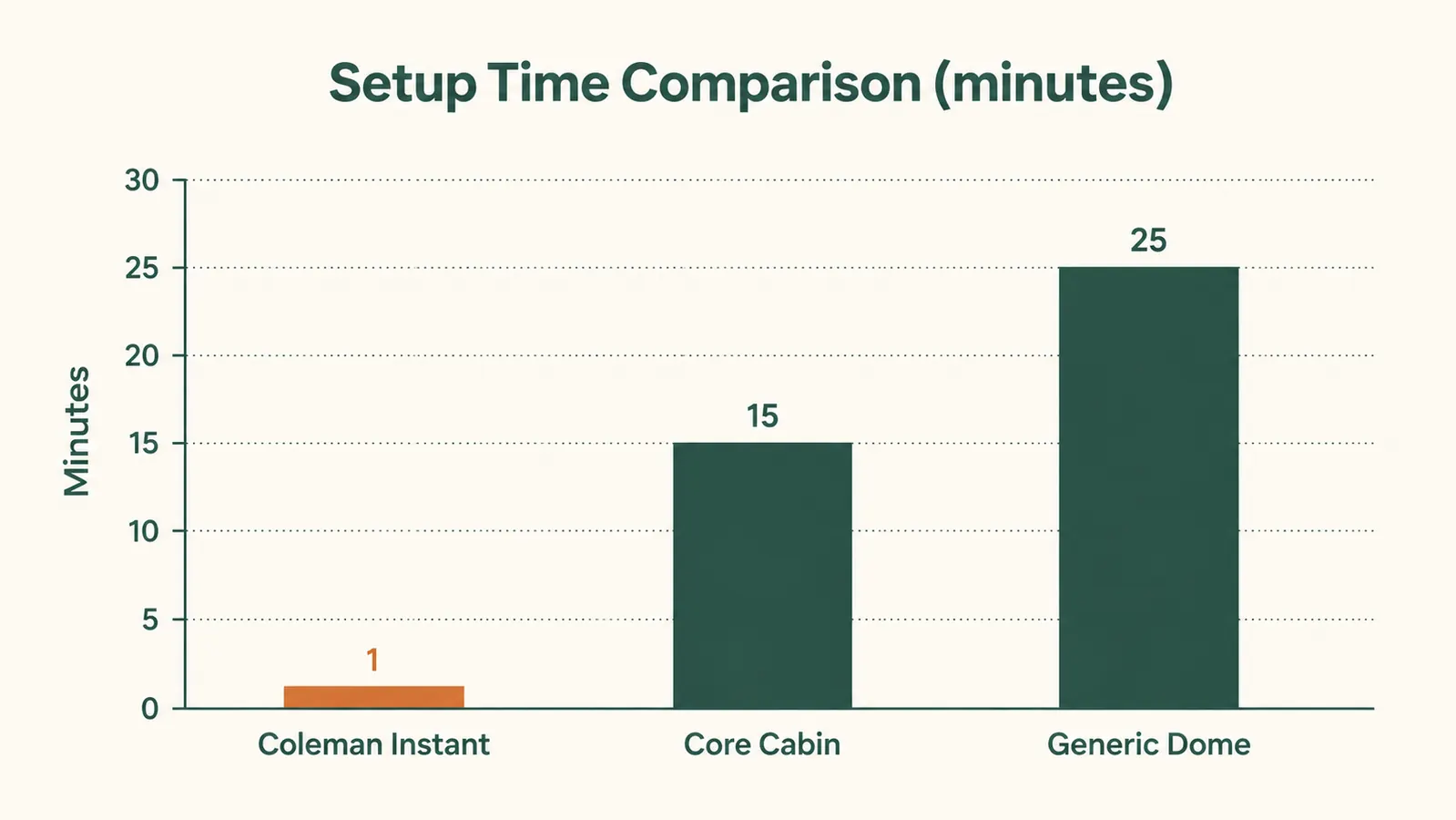
Coleman calls it a 1-minute setup, and that number is achievable under good conditions with one experienced adult. My first solo setup took about 4 minutes because I had not unfolded the frame fully before trying to lift it. Once I understood the unfolding sequence, I got it down to 90 seconds reliably. With two people, the whole thing including stake-out takes about 4 minutes on flat ground.
The pre-attached poles are the real feature here. Traditional tent assembly with separate poles, pole sleeves, and clips is genuinely annoying with kids around. The Instant Tent frame is one connected unit that folds accordion-style into the carry bag. You unzip the bag, pull the folded frame out, lay it flat, unfold it outward like opening a folding table, and then lift the center to let the dome shape snap into position. Attach the rain fly, stake the four corners, and you are done. There is no threading poles through fabric tubes.
The tradeoff for that folded pole design is bulk. The 25-inch bag is not small. It fits fine in a large trunk but if you are trying to jam it into a compact car with a full camping load, plan ahead. Also note: after three seasons, the folded pole joints make a slight creak when unfolding in cold weather. Nothing structural, just the sound of cold metal. It has not affected performance.
Floor Space and Livability: 68 Square Feet in Practice
The 6-person version has a 10-by-9-foot floor plan, which is 90 square feet of total interior footprint, but the usable flat floor area is closer to 68 square feet once you account for the tapered walls at the edges. Coleman rates it for 6 sleeping people, which is true if all six are in sleeping bags lying straight. In practice, we sleep two queen air mattresses side by side for the adults, and the kids lay on sleeping pads in the front section of the tent. That setup works with room to spare, there is a strip along one wall where we stack dry bags and gear.
Peak height is 6 feet at the center. I am 5-foot-11 and can stand upright in the middle without duck-walking, which matters more than you would think after a cramped night in a previous tent. The two doors (one at each end) are a functional feature that actually gets used. On warm nights, I can unzip both doors and the two mesh panels on each side simultaneously, and airflow is genuinely good. On humid nights in August, the tent breathes well enough that I did not wake up to condensation dripping on me, which has happened in cheaper tents with less vent area.
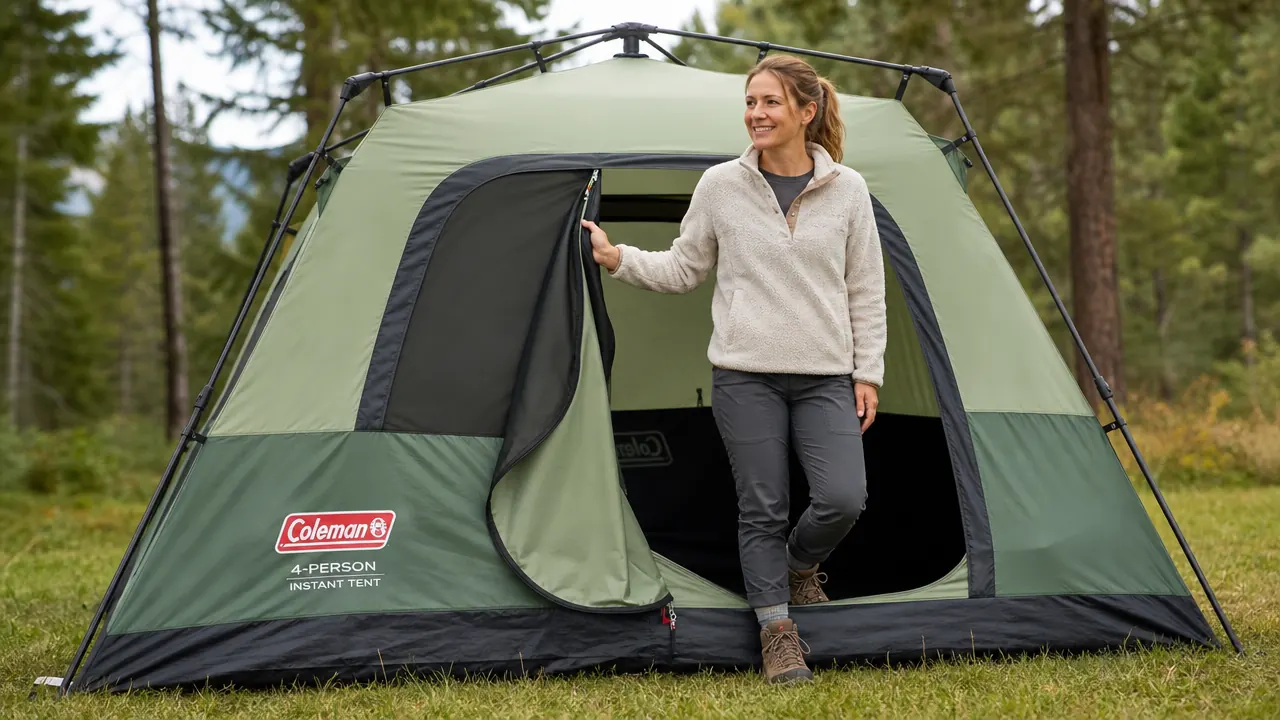
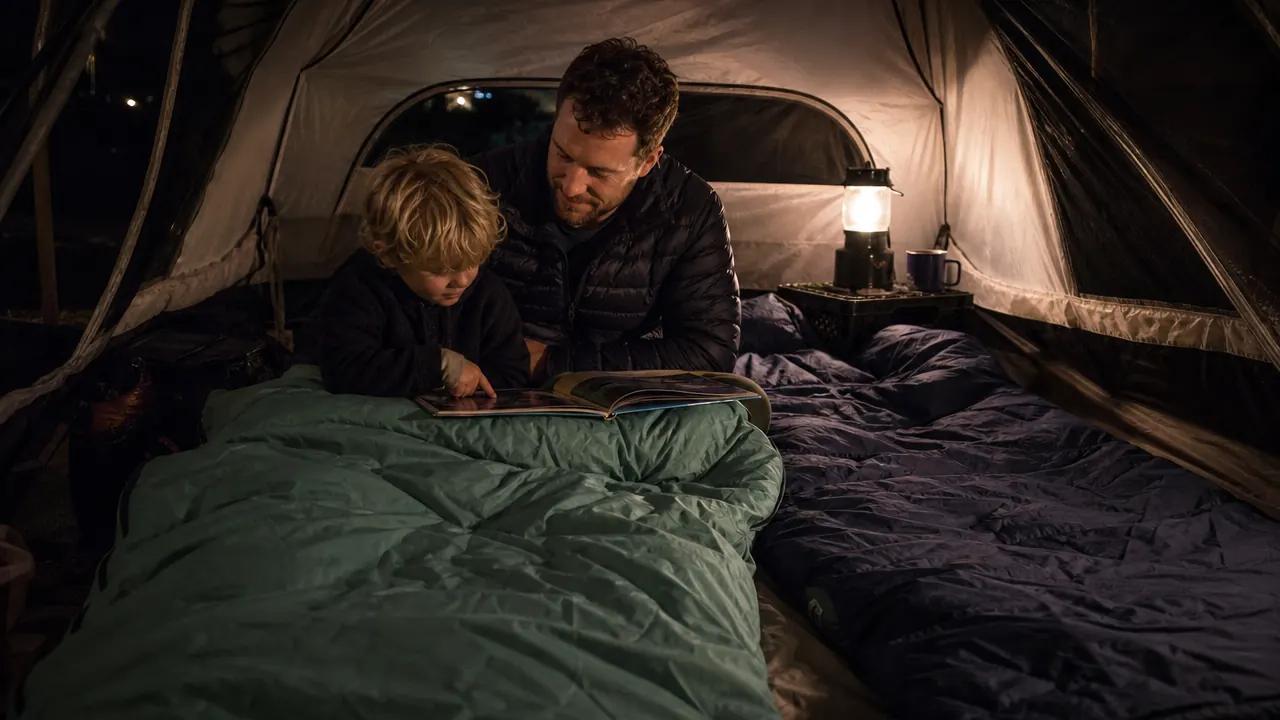
Two queen air mattresses fit side by side with space left along the wall for gear. Standing height at the center is 6 feet. This is the first family tent we have owned where nobody is sleeping against a sloped wall.
Rain Performance: Honest Numbers on a 1000mm Rain Fly
The Coleman Instant Tent's rain fly is rated at a 1000mm hydrostatic head. To translate that into plain terms: 1000mm is adequate for light to moderate rain and qualifies as water-resistant, not waterproof by most technical standards. Serious backpacking tents run 1500mm to 3000mm. For a car-camping tent at this price, 1000mm is typical, and in my experience it performs appropriately for that rating.
The hard rain test I referenced earlier was a three-hour downpour at Silver Falls State Park in Oregon, with gusts pushing the rain sideways for about 45 minutes of that stretch. The tent stayed dry inside during the main body of the storm. Where I got water was at the two door zippers on the windward side, where blowing rain worked its way through the zipper teeth during the heaviest gusts. This is a known weak point on any tent with two-way zippers that do not have a full overlap flap behind them. Coleman's door design does include a fabric flap, but during a driving sideways rain the flap does not fully cover the lower zipper track. My fix: I now position the tent so the doors face away from the prevailing wind direction, and I put a folded towel just inside each door threshold on rain nights.
The floor held completely. No pooling, no wicking through the bathtub floor. The seams on the floor felt dry the next morning after the heavy rain. The rain fly seams are factory taped, which I appreciate, but I still applied a coat of seam sealer before the second season as a precaution. If you skip that step, watch the corners of the fly where the fabric meets the pole clips.
Durability After 14 Trips: What Holds and What Shows Wear
The fiberglass poles are the first thing I looked at going into year three, because fiberglass pole failures are a known issue on budget and mid-range family tents. After 14 setups and teardowns, the poles are intact with no cracks or splintering. The pole tips that mate with the corner grommets have slight aluminum wear marks from repeated insertion, but nothing that affects function. I cannot tell you the pole denier because Coleman does not publish it, but the walls feel like approximately 68-denier polyester, which is standard for the category.
The zippers on the doors are the component I watch most carefully, because that is where family tents usually fail first. After three seasons, both main door zippers run smoothly with no catching, which is better than I expected. The mesh window zippers on two of the four panels have developed a slight stiffness when unzipping in cold weather, nothing that requires two hands yet, but I notice it. A small dab of zipper lubricant in the fall before storage would probably prevent this from progressing.
One real wear point: the carry bag zipper. The main zipper on the stuff sack started fraying at the pull tab end after about trip 8. It still works, but it looks like it will need replacing or repairing within another season or two. This is annoying because the bag design requires you to force the folded pole bundle back in at a precise angle, and if you fight the bag a little, the zipper takes the stress. My current habit is to roll the tent fabric first, then feed the pole bundle in with the bag unzipped as wide as possible.
What I Liked
- 90-second solo setup once you know the pole-unfolding sequence
- 6-foot standing height at center means no crouching during setup or use
- Two full doors plus four mesh panels create strong crossventilation on warm nights
- Pre-attached pole frame eliminates the most frustrating part of tent assembly
- Factory-taped seams on both fly and floor
- 23,866 reviews on Amazon averaging 4.3 stars, genuinely tested at scale
Where It Falls Short
- 1000mm rain fly rating is adequate, not heavy-weather capable; seam-seal before your first rainy trip
- At 20.5 lbs, the carry bag requires two people or one strong adult to move any distance
- Carry bag zipper shows wear by trip 8; the bag design stresses the zipper during repacking
- The door zipper flaps do not fully block sideways-driven rain; position doors downwind in storms
- No gear loft or overhead storage pockets, small organizational drawback for full-family occupancy
- Fiberglass poles are lighter than aluminum but will not absorb as much stress in a windstorm above 35 mph
Who This Tent Is For
This tent is built for car-camping families and couples who value fast setup, real standing room, and enough floor space to sleep six adults in sleeping bags or four people on air mattresses with space for gear. If your priority is getting camp set up fast after a 3-hour drive with tired kids, the Coleman Instant Tent solves that specific problem better than anything else I have used at this price point. It is also well-suited for couples who want a dedicated gear-storage area inside the tent, since the extra space beyond two sleepers is substantial.
Who Should Skip It
Skip this tent if you regularly camp in exposed sites during high-wind or heavy-rain seasons. Fiberglass poles and a 1000mm rain fly are not the right tools for Pacific Northwest fall camping or Great Plains spring storms. You want an aluminum-pole tent with a 2000mm-plus fly and full-coverage vestibule for those conditions. Also skip it if you need to hike to your campsite. The 20.5-lb weight and 25-inch bag are genuinely designed for vehicle access only. Finally, if you are a solo or two-person camper who does not need the space, there are lighter tents at a lower price that will serve you better.
Alternatives I Considered
Before settling on the Coleman Instant Tent, I looked hard at the CORE 6-Person Instant Cabin Tent. The CORE has a slightly taller peak height (78 inches versus 72 inches on the Coleman) and a room divider that creates a separate sleeping area, which appeals to families who want a visual separation between adult and kid zones. The CORE also uses a full-coverage rain fly that reaches closer to the ground on the sides. For full detail on how those two compare on weather resistance, floor space, and pole quality, see my comparison piece on the Coleman Instant Tent versus the CORE Cabin Tent.
I also looked at the REI Co-op Base Camp 6. Heavier-duty aluminum poles, much better foul-weather rating, and a price that runs nearly twice what the Coleman costs. If I were doing shoulder-season camping at elevation consistently, I would probably own the REI tent instead. But for our pattern of warm-weather weekend car camping trips to established campgrounds, the Coleman's performance-to-price ratio makes more sense.
Internal Links
For a different angle on the same tent, see my honest review of the Coleman Instant Tent that covers what no one tells you about the condensation and ventilation tradeoffs at coleman-instant-tent-honest-review. If you are trying to decide whether an instant-setup tent is worth the premium over a traditional pole tent for family camping, the 10 reasons piece at 10-reasons-instant-tent-worth-it-families covers that question directly. And if you already own one and want to nail the setup sequence, the step-by-step walkthrough at how-to-set-up-a-family-tent-in-under-two-minutes covers the exact pole-unfolding order and stake placement for rain.
Three seasons in, I still reach for this tent first. Here is today's price on Amazon.
The Coleman 6-Person Instant Tent has 23,866 reviews averaging 4.3 stars, pre-attached poles that cut setup to 90 seconds, and 68 square feet of livable floor space. If your current tent takes 20 minutes and a diagram, this is worth a look.
Amazon Check Today's Price on Amazon →