
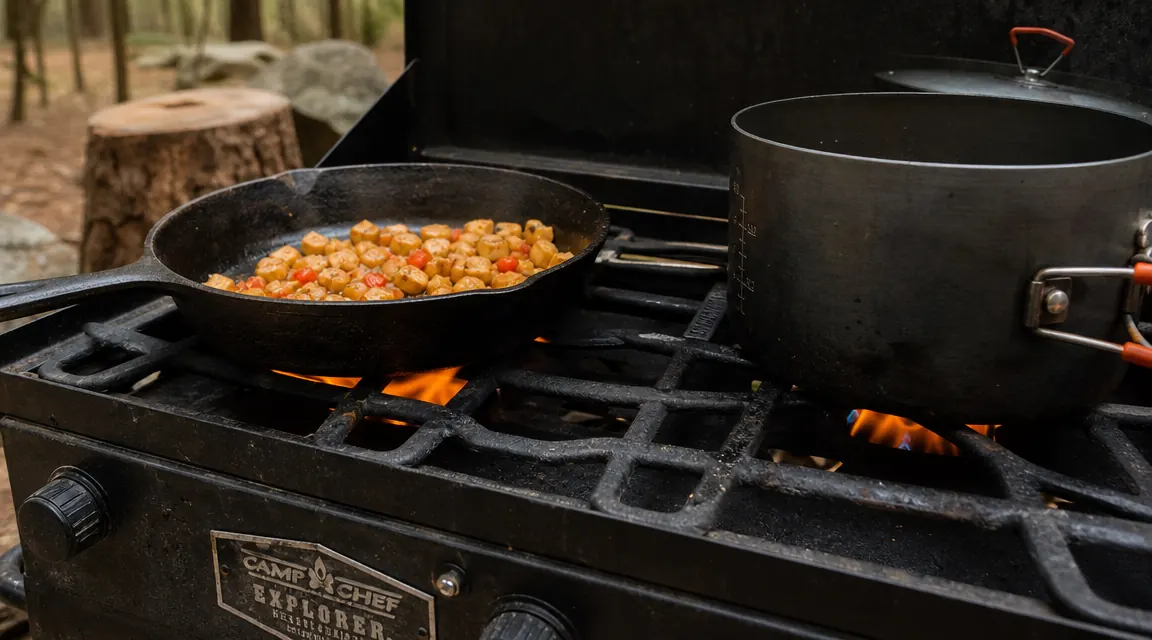
I bought the Camp Chef Explorer EX60LW on the recommendation of a guy three campsites over who was making proper carnitas on a Saturday morning while the rest of us were eating granola bars. He said, go get that one. So I did. That was three years and somewhere north of forty weekend trips ago. And I want to tell you the things he did not tell me, because there are a few.
What nobody mentions upfront: this stove is 12.3 lbs. That sounds manageable until you realize you are also carrying a one-pound propane canister and a cast iron skillet. If you are backpacking or doing ultralight anything, stop reading. This stove is for people who drive to their site and have room in the truck bed. If that is you, keep going, because the weight is the only real downside.
The Quick Verdict
The best mid-range car-camping stove if you cook real food, but the 12-lb carry weight and cold-morning pressure drop will frustrate you until you learn the workaround.
Amazon Check Today's Price →Tired of coaxing a camp stove to life at 40 degrees while your coffee stays cold?
The Camp Chef Explorer EX60LW is 30,000 BTU per burner with a matchless ignition and a modular leg system that levels on uneven ground. Check today's price on Amazon before the next camping season closes the deal.
Amazon Check Today's Price on Amazon →What I Expected vs What I Found
I expected a big, competent stove that would cook fast. That part is accurate. What I did not expect was the regulator behavior in cold weather. On a 38-degree morning in November at a campsite in the Uinta Mountains, I lit both burners on high and they ran fine for about four minutes. Then the right burner started losing flame height. Not sputtering, not dying, just gradually shrinking from a robust blue ring down to something that looked more like a pilot light.
This is not a defect. It is basic propane physics. When ambient temperature drops below about 40 F, the liquid propane in the tank has trouble vaporizing fast enough to maintain full pressure at the regulator. The Explorer uses a standard low-pressure regulator set at roughly 0.4 PSI, and that regulator is only as good as the pressure the tank delivers. On a cold morning, especially with a tank that is below half full, you will see this. The fix is simple: warm the propane canister in your sleeping bag for ten minutes before cooking. But I had to figure that out myself.
The matchless ignition also has one honest limitation: it works every single time in warm weather and about 80 percent of the time below 45 F. Keep a lighter or a match nearby. This is not a Camp Chef problem, it is a piezoelectric igniter problem across every brand at low temperatures.
Wind Performance: The Real Story
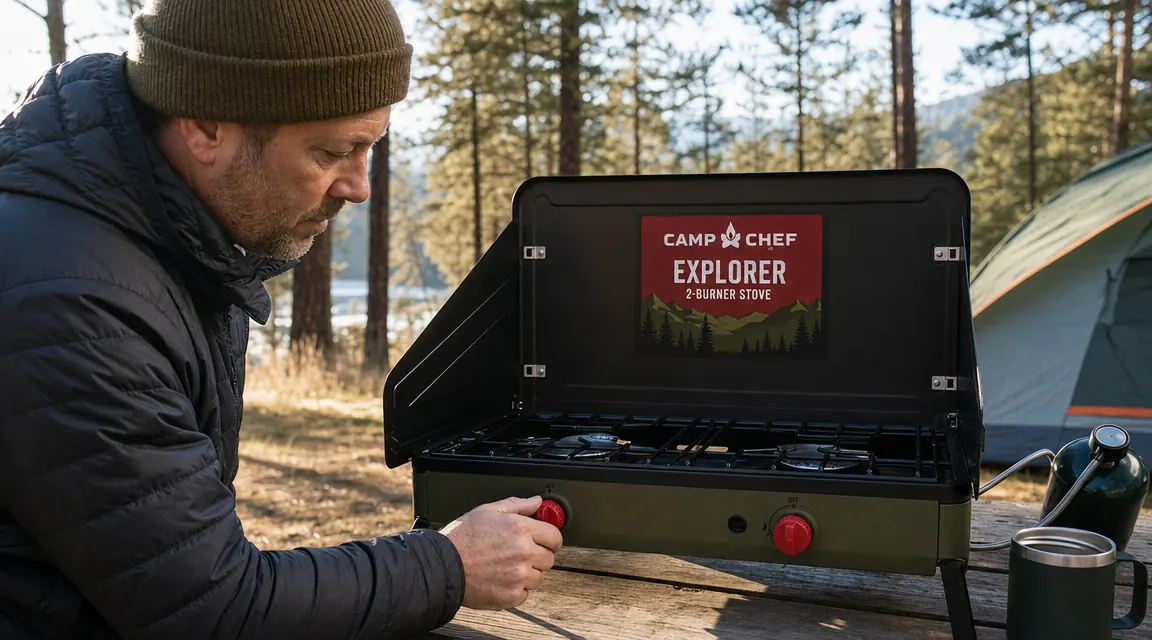
The Explorer has fold-up windscreen panels on three sides. They are not decorative. In a light 10-12 mph wind they make a real difference, maybe two minutes shaved off a 1-quart boil. In a genuine 20-plus mph gusting wind, the panels help but they do not solve the problem. I camped at a site on the Wyoming border in late September where the wind came in sustained at around 25 mph with gusts that bent the folding chairs. The left burner held flame. The right burner would not stay lit above medium.
The practical fix: orient the stove so the open side of the windscreen faces away from the prevailing wind, and cook at medium rather than high if you are fighting real gusts. On high, the flame spreads wide and gets more surface area exposed to crosswind. On medium, the burner runs a tighter, deeper flame that stays lit. Once I understood that, the stove became reliable in conditions that would have put a Coleman camping stove out of business.
On medium, the Explorer runs a tighter flame that holds in wind that would kill a Coleman's high setting. It took me two trips to figure that out.
Cast Iron: The Reason the Extra Weight Exists
The Explorer's grates are rated to handle 80 lbs per burner. I have run a 10-inch Lodge cast iron skillet (5.4 lbs empty), a 12-inch Lodge griddle (8 lbs), and a 6-quart Dutch oven (13.5 lbs filled) on these grates without any sag or lateral movement. The grate itself is a hefty cast iron structure, not a stamped steel rack. That is a large part of why this stove weighs what it weighs.
For cast iron users, this matters enormously. Most lighter camp stoves use thin wire or stamped steel grates that flex under a Dutch oven and can tip a skillet sideways on uneven ground. The Explorer does not do that. The combination of heavy grates and the leveling legs means a 13-lb Dutch oven of chili sits rock-steady over a simmer for two hours. That is not something most camp stoves can promise.
The 30,000 BTU output per burner is real and it matters for cast iron specifically. Cast iron takes longer to reach working temperature than stainless or aluminum. With 30,000 BTUs you can bring a 10-inch skillet to cooking temp in about four minutes at full output. On a 15,000 BTU burner, that stretch is closer to eight minutes. When you are making pancakes for four people who have been up since 6am, four vs eight minutes is not trivial.
The Modular Leg System: Gimmick or Genuinely Useful
Camp Chef markets the Explorer's modular attachment system prominently. The idea is that you can add accessories like a griddle, a pizza oven, or a grill box using the same burner platform. I have used the griddle attachment on four trips. It works. The griddle sits over both burners and gives you a full flat surface for cooking eggs, sausage, or smash burgers. Cleanup is easier than a skillet because the drip tray catches grease.
The leg system itself has a separate practical value: the legs are individually adjustable, so you can level the cooking surface on uneven ground. Campsite picnic tables are almost never perfectly flat, and the leveling feature is legitimately useful when you have liquid in a pan. The legs also fold in for transport and lock in a way that does not rattle loose in the truck. After three years, mine have never needed adjustment or tightening.
One honest note: the accessory attachment system uses a proprietary interface. The griddle attachment costs extra and is only compatible with Camp Chef stoves. If you switch brands, you start over on accessories. That is worth knowing upfront.

Failure Modes After Three Years
Here is what has actually gone wrong or worn over three years of regular use. First: the rubber gasket on the regulator hose fitting got stiff after about two seasons. It still seals properly, but I check it at the start of every season now with soapy water. No leaks found, but I notice it has lost some of its original pliability. Camp Chef sells replacement hoses at a reasonable price, and I plan to swap mine proactively next season.
Second: the carry latch. The Explorer folds flat and latches closed with a plastic clip. The clip cracked at the hinge point sometime during year two. The stove still latches, but the clip has a hairline fracture that I expect will eventually fail. A bungee cord handles the job fine in the meantime. Camp Chef customer service sent me a replacement clip for free when I described the issue by email. That was a good experience.
Third: one of the burner knob indicator markers wore off. The red painted line that shows where LOW and HIGH are positioned on the knob. This happened from repeated propane-and-grease cleaning. It is purely cosmetic, but it means I calibrate by feel and flame height now rather than the knob indicator. Not a real problem, but worth noting for someone who relies on visual reference marks.
What I Liked
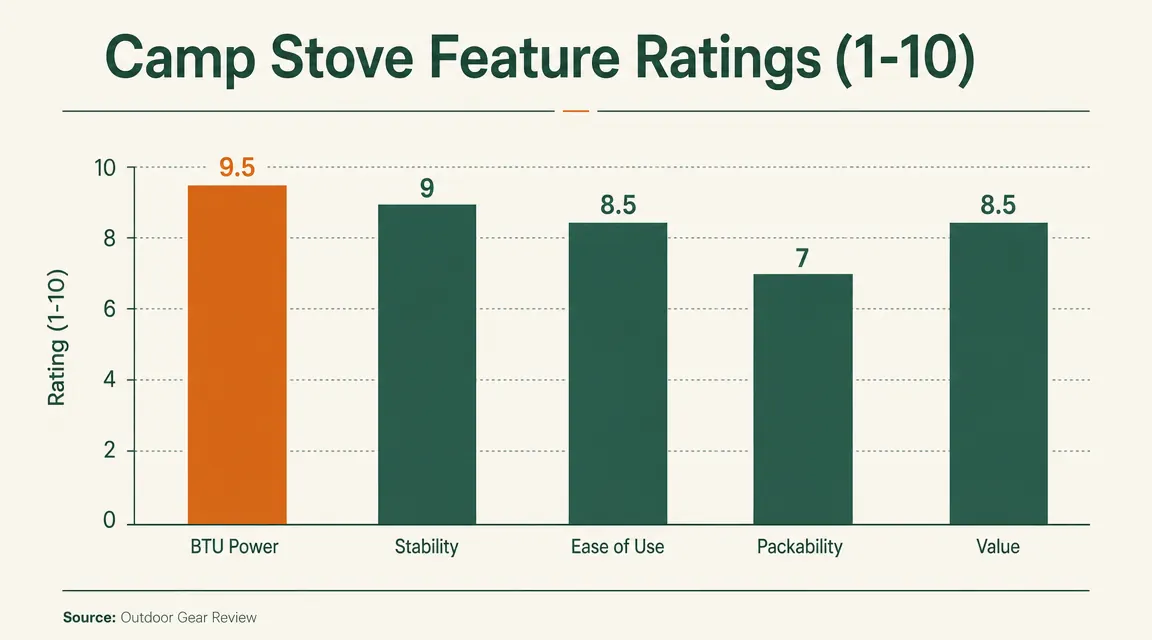
- 30,000 BTU per burner handles cast iron, Dutch ovens, and wok cooking without straining
- Modular legs level reliably on any surface and fold solid for transport
- Grates rated at 80 lbs per burner hold a full Dutch oven without flex or tip
- Three-sided windscreen panel provides real protection up to about 15 mph wind
- Matchless ignition lights instantly in warm to moderate temperatures
- Camp Chef sent a replacement carry clip for free with no hassle
Where It Falls Short
- 12.3 lbs before accessories or fuel, too heavy for anyone who has to carry it more than 50 feet
- Regulator drops pressure below 40 F with a tank under half-full; requires a warm-tank workaround
- Piezoelectric ignition fails about 20 percent of the time below 45 F; bring a lighter
- Carry clip is plastic and prone to cracking at the hinge within a season or two
- Accessory attachments use a proprietary interface, no mixing with other brand cookware systems
Who This Is For
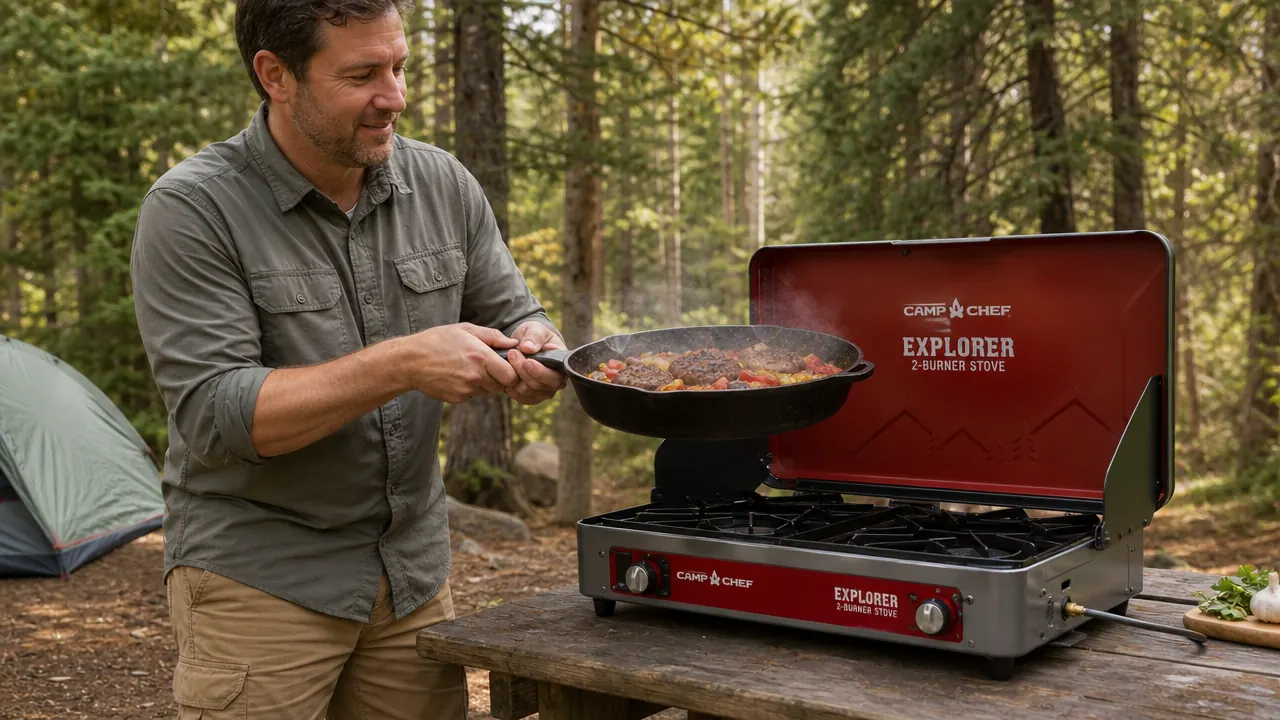
The Explorer earns its keep if you cook real meals at camp. By real meals I mean anything that requires two burners running simultaneously, serious heat for searing, or the weight tolerance for cast iron. Car campers feeding four or more people, anyone who uses a Dutch oven or a cast iron griddle, and campers who trip in shoulder season when a 30,000 BTU head start on a cold morning matters, these are the buyers who will use every feature this stove offers and not resent the weight.
If you are cooking two people's meals for three-season camping with a standard saucepan and a cheap nonstick, you could run a lighter stove at half the weight and two-thirds the price and not miss anything. The Explorer is not better for simple cooking. It is specifically better for serious cooking.
Who Should Skip It
Skip the Explorer if weight is your constraint. A Coleman Triton at 7.5 lbs puts out 22,000 BTU per burner and handles most camp cooking competently. You will notice the difference with heavy cast iron, but for standard stainless cookware you will not. Skip it also if you primarily winter camp or camp above 8,000 feet regularly with small tanks, where the cold-temp pressure issue is a consistent annoyance rather than an occasional one. And skip it if you have never owned a camp stove before and want something low-maintenance to learn on. The Explorer rewards people who know how to use it.
If you cook real food at camp and you are done fighting a weak-flame stove, the Explorer is the answer.
30,000 BTU per burner, 80-lb grate load rating for cast iron, and a modular leg system that levels on any surface. The Explorer has a 4.7-star rating across 9,450 reviews for a reason. See today's price on Amazon.
Amazon Check Today's Price on Amazon →