
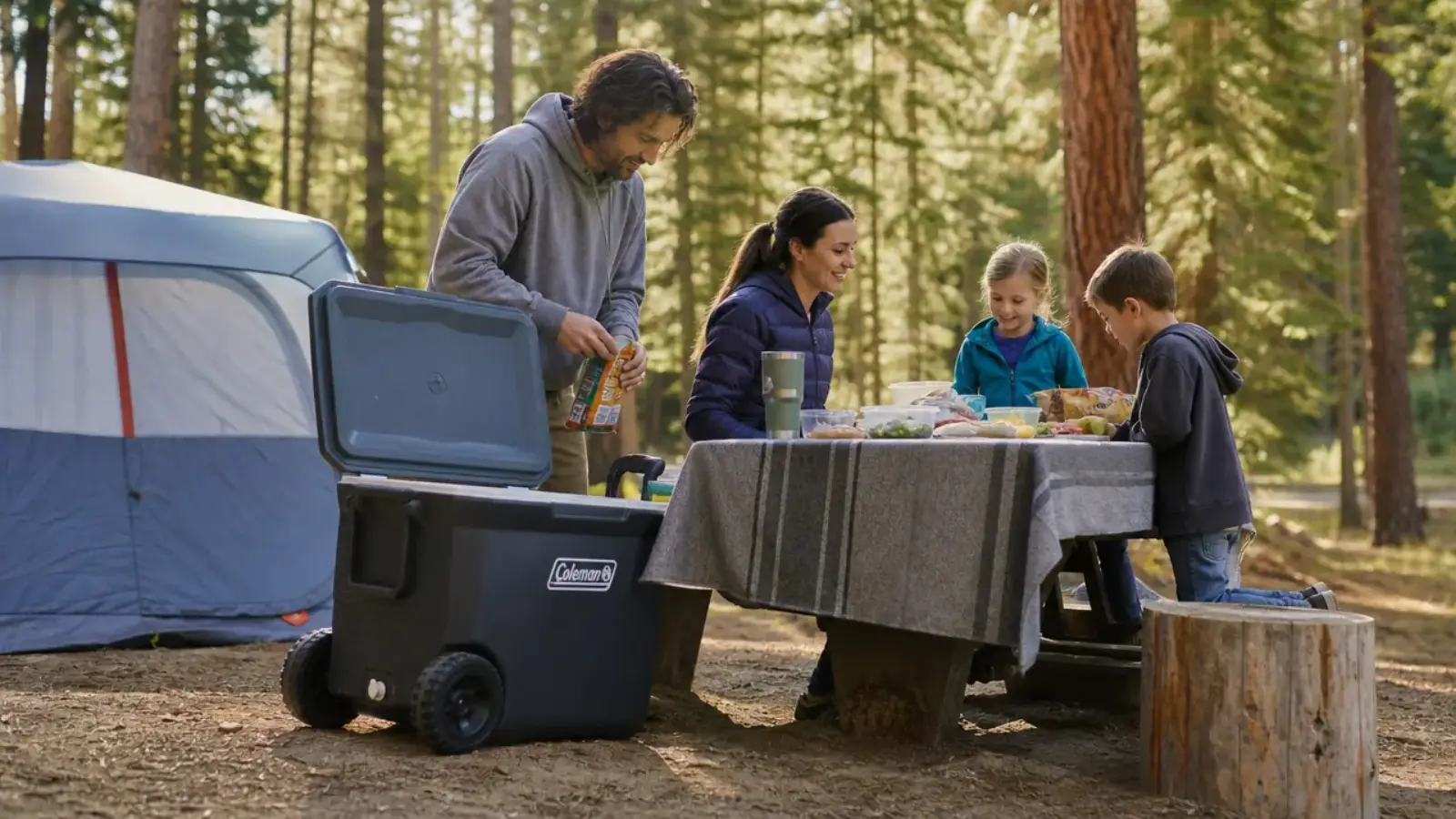
I have been car camping for about 14 years and for the first eight of those I used a standard 54-quart chest cooler. It weighed 11 lbs empty. Packed with three days of food and 20 lbs of ice it hit 63 lbs. My camp setup is a pull-in site at a state park, gravel surface, about 35 feet from the parking spot to the picnic table. That 35 feet felt like a quarter mile every Friday night when we arrived after a two-hour drive. Last summer I switched to the Coleman Classic rolling cooler with wheels and the cooler problem just stopped being a problem.
The rolling cooler on wheels concept sounds obvious until you have done both. Then it becomes the kind of thing you cannot believe you waited this long to try. These are the ten reasons a rolling cooler wins for car camping, all drawn from real use.
Stop doing a two-person carry every time you need a cold drink.
The Coleman Classic 62-quart rolling cooler has a telescoping handle, hard plastic wheels rated for gravel, and foam insulation that keeps ice for up to 5 days. Over 8,000 campers rate it 4.5 stars.
Amazon Check Today's Price on Amazon →One person moves it instead of two
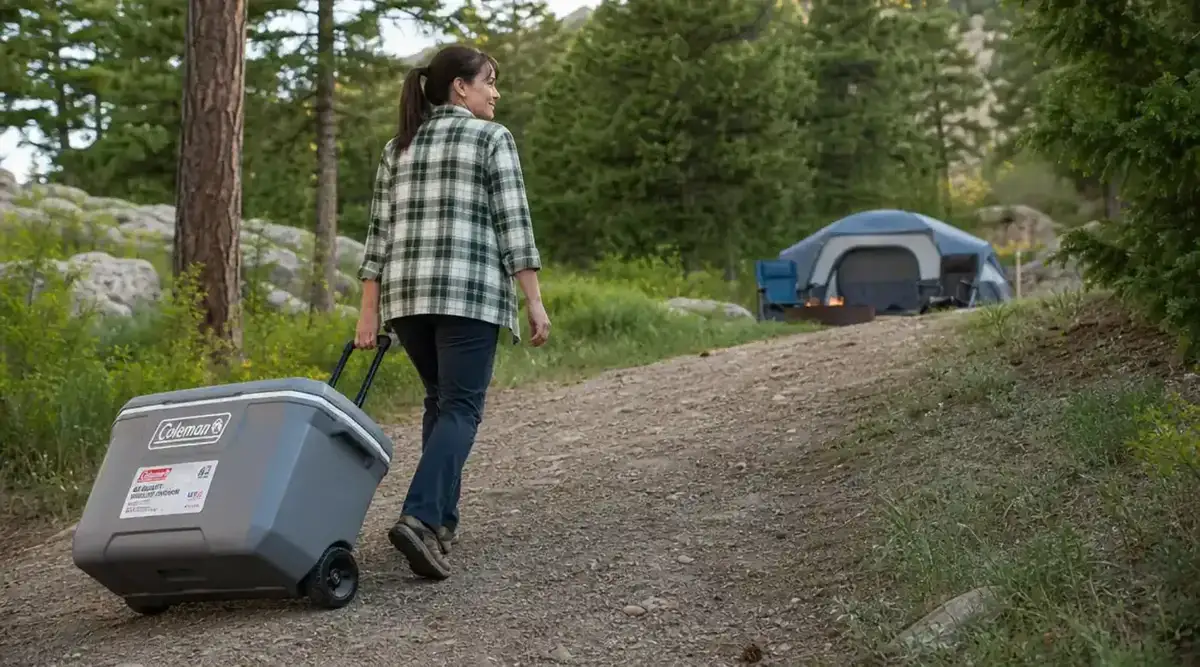
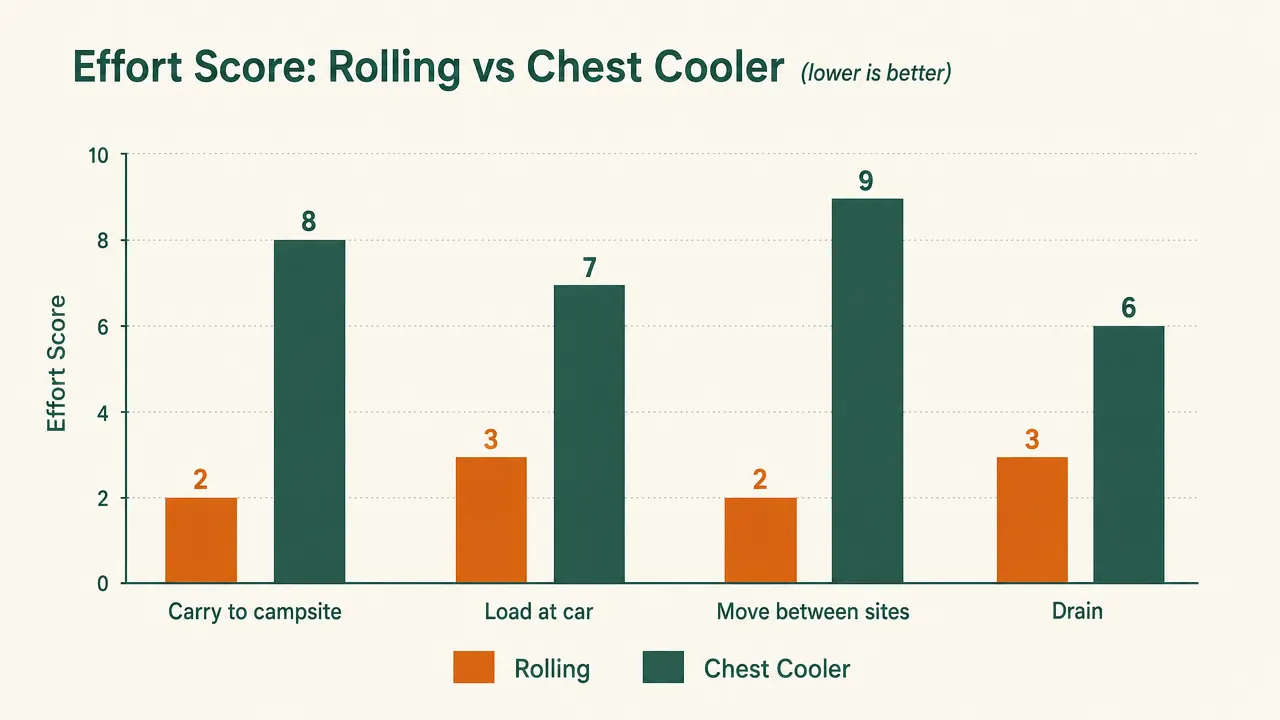
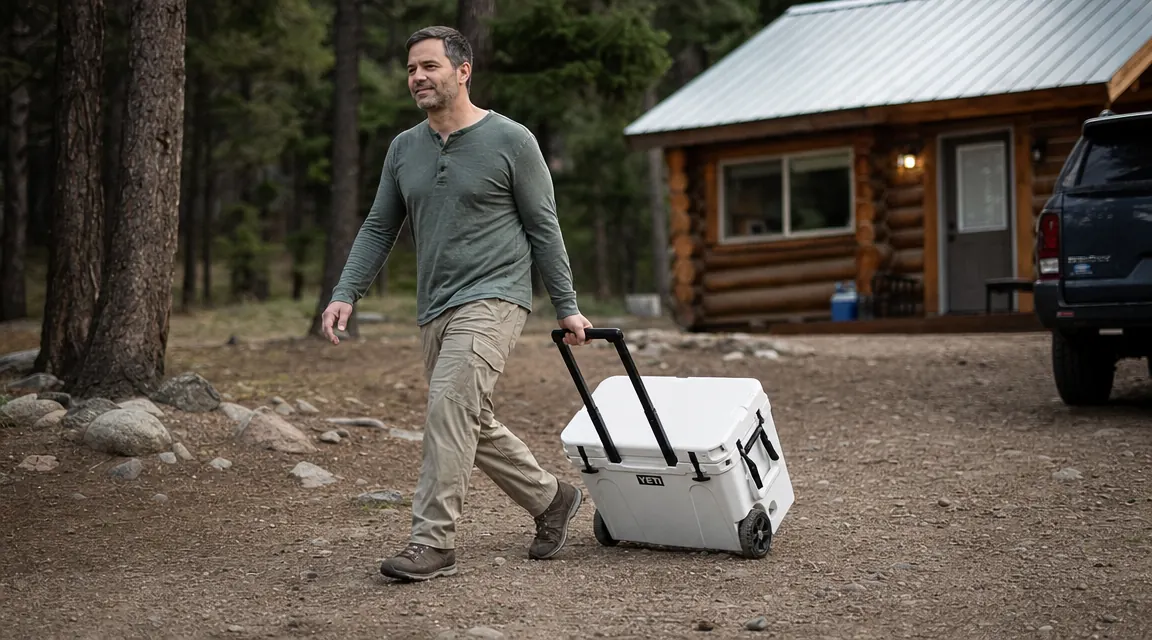
A 62-quart rolling cooler packed with ice and food weighs roughly 70 lbs. That is a two-person carry if it has no wheels. With the telescoping handle extended and the hard plastic wheels rolling on gravel, one adult can pull it solo. Friday night arrival goes from a coordinated lift to a one-hand drag. That is not a small thing when you are also carrying a sleeping bag and a lantern.
Gravel and dirt paths are not a problem
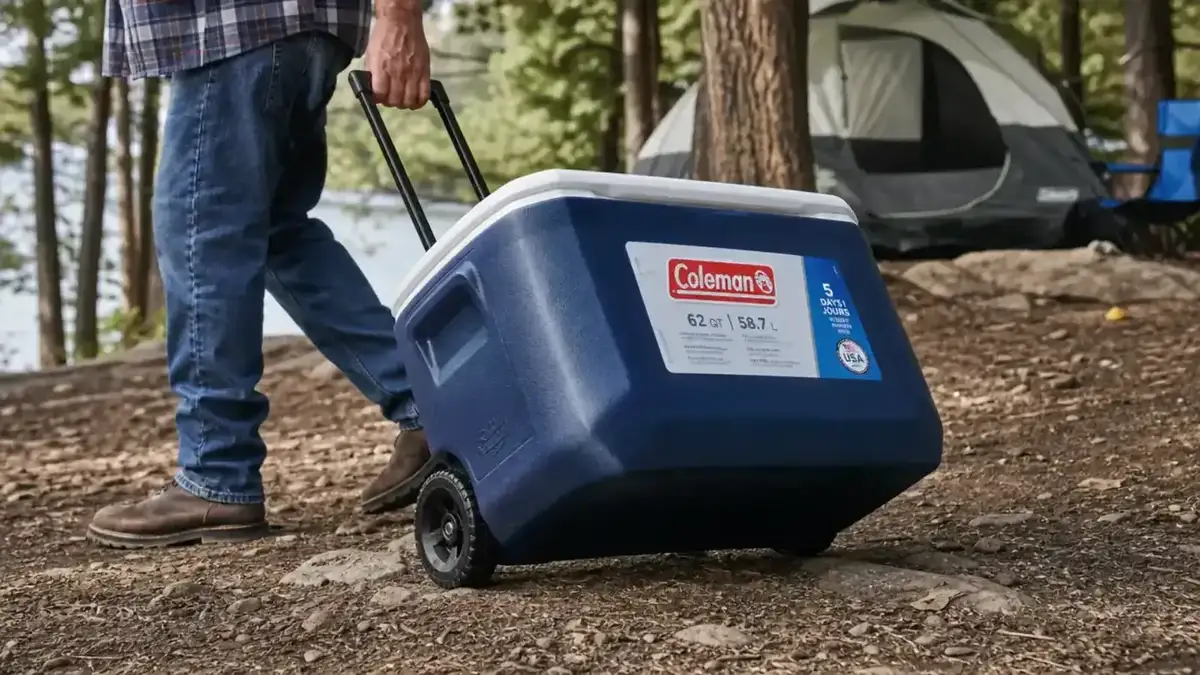
Car camping sites are not smooth floors. Most are gravel, packed dirt, or a mix of both. The wheels on a rolling cooler with wheels are hard plastic, typically about 3 inches in diameter, and they roll over small gravel without binding. I have pulled the Coleman across the rough gravel at Mohican State Park twice now without the wheels hanging up. A small tip forward on the handle clears any rocks that try to catch.
The 62-quart capacity fits a full weekend of food for four
Sixty-two quarts is 68 standard 12-oz cans plus ice, or roughly 50 lbs of food and a 15-lb bag of block ice with room to spare. My family of four does a three-night trip using one cooler load without a restock. A standard 54-quart chest barely holds the same haul, and you are picking between drinks or the food container. The extra 8 quarts in the Coleman buys you the beer shelf.
Ice lasts up to 5 days with the right packing method
Coleman rates the insulation on this cooler at 5 days of ice retention. In my testing last July, packed with block ice on the bottom and cubed ice on top, we hit four days before the ice was mostly water and the food temp started climbing. That is in-line with Coleman's spec given that we were opening it eight times a day. For how to squeeze the most out of that insulation, the packing walkthrough in how to keep food cold camping for five days is worth reading before you leave.
The telescoping handle locks at two heights
Taller campers know the problem with a fixed-height cooler handle: you end up hunching over to pull it. The Coleman's telescoping handle extends to a comfortable pulling height for adults between 5'5" and 6'2" and locks with a button at two positions. My 12-year-old pulls it at the lower setting; I pull it at the upper. Neither of us has to awkwardly bend over a gravel campsite dragging a box.
Friday night arrival went from a two-person carry and a strained back to one hand on the telescoping handle and 35 feet of gravel. That is the entire upgrade.
The leak-resistant drain plug actually drains without flipping the cooler
This sounds minor until you have ever tried to drain a chest cooler that weighs 45 lbs of ice water. Traditional chest coolers have a drain plug at the bottom, which means you either tip the cooler (a two-person job once it is partially full) or you open the lid and ladle out meltwater with a cup. The Coleman rolling cooler drain plug is at the lower rear corner and releases meltwater while the cooler sits upright. Open the plug, let it run out, close it. Thirty seconds.
It doubles as a seat or step at the campsite
A loaded 62-quart rolling cooler is a stable flat surface. The lid supports about 250 lbs according to Coleman's spec sheet. I use it as a seat when the camp chairs are occupied, or as a step to reach the top of my roof rack. A traditional chest cooler with a dome lid or a flexible lid seal is not stable to sit on. Flat lid, rigid construction, and the fact that it does not roll away when you sit on it (wheel locks, covered in reason 8) make it work.
The wheel locks keep it stationary on sloped sites
Most campground pull-in sites are not perfectly flat. They slope toward a drainage ditch or just follow the natural ground. The Coleman rolling cooler has a small locking tab on each wheel that clicks into a stop position. Flip the tab with your toe and the wheels lock. Without this, a loaded 70-lb cooler would slowly roll into your tent on a 3-degree slope. It is a simple feature that a chest cooler does not need, and it is good that it is here.
It loads into a truck bed or SUV cargo area without a team lift
Loading a chest cooler into a truck bed requires two people and clear communication about the three-count lift. The rolling cooler handles differently: tilt it back on the wheels, slide it to the vehicle, then tip it up and in. One person can load a fully packed 62-quart rolling cooler into a standard-height cargo area. The handle also gives you a stable grip point during the load, which a chest cooler without built-in side handles does not provide.
The price is in line with a basic chest cooler of the same capacity
A 54-62 quart traditional chest cooler without wheels runs in a wide range depending on insulation quality and brand. The Coleman 62-quart rolling cooler sits at current pricing in the mid-range. You are getting the same foam insulation rating, the same Coleman build quality, and you are adding wheels and a telescoping handle. The price delta between a decent lidded chest and this rolling cooler is small enough that there is no real cost argument for the no-wheels version. For a full breakdown of what you get at this price point, the Coleman rolling cooler review goes into the detail on build quality and what wears first.
What I Would Skip
The rolling cooler is not for every situation. Backpacking is the obvious one. You are not rolling anything on a trail. Canoe camping on rivers with rocky portages is another case where wheels do not help. And if your campsite is a flat concrete slab with parking directly next to it, the carry advantage disappears. In those cases a lighter traditional cooler makes more sense. But for car camping on a gravel or dirt surface, with a 20-foot carry between your vehicle and the site, this is the version I would reach for every time.
There is no real cost argument for the no-wheels version when the price gap is this small and the carry difference is this large.
Your back is going to appreciate the wheels on the very first trip.
The Coleman Classic 62-quart rolling cooler is rated 4.5 stars by 8,159 campers. It keeps ice for up to 5 days, drains without tipping, and moves with one hand across gravel and dirt.
Amazon Check Today's Price on Amazon →